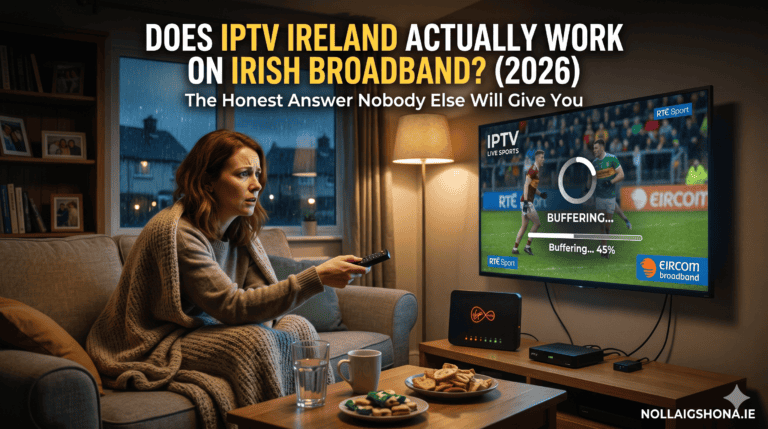
You’ve heard the pitch. 18,000 channels. 4K quality. Every GAA match. Every Premier League fixture. All for less than a tenner a month. Sounds class. But then you look at your broadband router blinking away in the corner — the same one Eir gave you three years ago that struggles to load a YouTube video when the kids are on their tablets — and you think: there’s no way this works in my gaff.
Fair question. And unlike most IPTV sites that gloss over the broadband reality with vague statements like “works with any internet connection,” this guide gives you the actual truth about how IPTV Ireland performs on real Irish broadband in 2026. The good, the bad, and the “it depends on which side of the road your cabinet is on.”
Because here’s the thing — IPTV works brilliantly for the majority of Irish households. But not all broadband is equal in this country, and pretending otherwise helps nobody. Whether you’re on Virgin Media in Drumcondra or a fixed wireless connection in rural Leitrim, this guide tells you exactly what to expect before you spend a cent.
The Broadband Baseline — What IPTV Ireland Actually Needs
Before getting into provider-specific details, let’s establish the technical requirements. These numbers are real, not marketing:
- 10 Mbps: Minimum for smooth HD (1080p) streaming on a single device. Watchable, reliable, no issues.
- 25 Mbps: Recommended for 4K Ultra HD on a single device. This is the sweet spot for most households watching on one TV.
- 50 Mbps: Comfortable for two or three devices streaming simultaneously. Dad watching the match in the sitting room, kids on tablets upstairs, partner streaming a series in the bedroom.
- 100+ Mbps: Overkill for IPTV alone, but provides generous headroom for households where everyone is online doing different things at once.
That’s it. No magic number. No “you need gigabit fibre or forget about it.” If your broadband delivers a steady 25 Mbps to your TV — and most Irish connections do — IPTV Ireland runs in 4K without breaking a sweat.
The key word there is “steady.” A connection that tests at 50 Mbps at 2pm but drops to 8 Mbps at 9pm when the neighbours are all streaming is effectively an 8 Mbps connection for evening viewing. Peak-hour performance matters more than headline speed.
IPTV Ireland on Eir Broadband — The Full Picture
Eir is Ireland’s largest broadband provider with the widest national footprint. But “Eir broadband” covers a massive range of connection types and speeds, which is why some Eir customers have a flawless IPTV experience while others struggle.
Eir FTTH (Fibre to the Home)
If you’re lucky enough to have Eir’s fibre-to-the-home service, IPTV Ireland runs perfectly. FTTH connections deliver 150 Mbps, 300 Mbps, or 1 Gbps with rock-solid consistency between off-peak and peak hours. Latency sits around 8–12ms, which means live sport plays virtually in real-time. No buffering during the All-Ireland final. No pixelation during a penalty shootout. No complaints.
Eir FTTH is available through the open eir network in an increasing number of Irish locations. Check availability at your specific Eircode — it varies street by street, and your neighbour having fibre doesn’t guarantee you do.
Eir FTTC (Fibre to the Cabinet)
This is where most Eir customers sit. Your connection runs on fibre from the exchange to a green cabinet on your street, then on copper wire from the cabinet to your house. Speed depends heavily on your distance from that cabinet.
If you’re within 500 metres of the cabinet, you’ll typically get 50–100 Mbps — more than enough for 4K IPTV Ireland streaming. Between 500 metres and 1 kilometre, speeds drop to 30–50 Mbps — still adequate for HD and single-device 4K. Beyond 1 kilometre on copper, speeds can fall below 20 Mbps, and IPTV performance becomes inconsistent, particularly during peak hours.
The honest call: if your Eir speed test at speedtest.net shows 25+ Mbps during the evening (test between 8pm and 10pm, not at lunchtime), IPTV will work well. Below 15 Mbps, expect occasional buffering during HD streaming, and 4K won’t be reliable.
Eir DSL (The Struggle Bus)
Some rural and older suburban Eir customers are still on pure DSL — the oldest broadband technology still in service. Speeds range from 3–24 Mbps depending on line quality and exchange distance. At the upper end (18–24 Mbps), HD IPTV is possible but not guaranteed during peak hours. Below 10 Mbps, IPTV streaming will be frustrating.
If you’re on Eir DSL below 10 Mbps, the honest advice is to check whether SIRO, Virgin Media, or National Broadband Ireland (NBI) has reached your area before subscribing to any IPTV service. The broadband is the bottleneck, not the IPTV.
IPTV Ireland on Virgin Media — Fast but Watch the Congestion
Virgin Media delivers some of the fastest broadband speeds in Ireland through their cable (HFC) network. Plans offering 150 Mbps, 250 Mbps, 500 Mbps, and 1 Gbps are available across their coverage area — primarily Dublin, Cork, Galway, Limerick, Waterford, and surrounding commuter towns.
At those speeds, IPTV Ireland should be absolutely flawless. And for most Virgin Media customers, it is. Multiple 4K streams running simultaneously, no buffering, no issues.
The caveat — and this is a genuine one — is congestion on Virgin Media’s shared cable infrastructure. Your connection shares bandwidth with other Virgin Media subscribers on your street. In apartment complexes and dense housing estates, peak-hour speeds can drop noticeably. A 500 Mbps connection might deliver 400+ Mbps at midday but 80–120 Mbps at 9pm on a Saturday when everyone’s watching the match.
Even at 80 Mbps, IPTV runs fine. But if you’re in a very densely cabled area — large apartment blocks in Dublin city centre, for example — and your peak-hour speed drops below 25 Mbps (rare but possible on older cable segments), you might notice occasional buffering during major live events when network demand spikes.
The practical test: run a speed test on a Saturday evening between 8pm and 10pm. If you’re getting 30+ Mbps, IPTV Ireland will be rock solid. Most Virgin Media customers clear this easily.
IPTV Ireland on Vodafone — The Quiet Achiever
Vodafone Ireland primarily resells fibre broadband through the open eir FTTH network and the SIRO network. This means the underlying connection is genuine fibre-to-the-home in most cases — the same physical infrastructure that Eir FTTH uses, just with Vodafone’s branding, pricing, and customer service.
For IPTV Ireland, Vodafone fibre is excellent. Consistent speeds at all hours, low latency for live sport, and no congestion issues because dedicated fibre doesn’t share bandwidth the way cable does.
Vodafone’s customer service also ranks better than Eir’s in most Irish satisfaction surveys, according to ComReg’s quarterly reports. When something goes wrong with your broadband and you need it fixed quickly so you don’t miss the match, faster support resolution genuinely matters.
The only limitation: Vodafone fibre availability depends entirely on whether open eir or SIRO infrastructure has reached your address. Their coverage is growing but doesn’t match Virgin Media’s urban reach. Always check Vodafone’s coverage map for your specific Eircode before assuming you can get fibre through them.
IPTV Ireland on SIRO — The Best You Can Get
SIRO deserves special mention because it delivers the most consistent broadband experience available anywhere in Ireland. Built on ESB’s electricity network infrastructure, SIRO provides 100% fibre from the exchange to your home — no copper, no cable, no shared segments.
For IPTV Ireland streaming, SIRO is as good as it gets. Speeds don’t fluctuate between peak and off-peak hours. Latency sits under 10ms. Jitter (the variation in connection stability that causes pixelation) is virtually zero. 4K streams load instantly and play without interruption regardless of what time it is or what’s happening on your street.
SIRO is available in over 50 towns and cities across Ireland — primarily outside Dublin, where ESB’s electricity infrastructure provided the rollout pathway. You access SIRO through retail partners including Vodafone, Digiweb, and Sky. Check siro.ie for availability at your address.
If SIRO is available where you live, choose it. For IPTV streaming — and frankly for everything else — it’s the best Irish broadband infrastructure available in 2026.
The Rural Ireland Question — NBI, Fixed Wireless & Starlink
This is the section that matters for roughly 30% of Irish households. If you live in rural Ireland — and “rural” in broadband terms can mean a housing estate 5 kilometres outside a county town, not just a remote farmhouse — your broadband options have historically been limited.
National Broadband Ireland (NBI)
The government’s National Broadband Plan, delivered by NBI, is rolling out fibre to over 560,000 premises in the “intervention area” — addresses that commercial providers won’t reach. As of 2026, NBI has connected a significant number of these premises, with the rollout continuing nationwide.
Where NBI fibre has arrived, it’s genuine FTTH delivering speeds comparable to SIRO and Eir FTTH. IPTV Ireland works perfectly on NBI connections. The challenge is the rollout timeline — if NBI hasn’t reached your townland yet, you could be waiting months or years.
Check nbi.ie for the rollout schedule at your Eircode. If your area is listed for connection within the coming months, it’s worth waiting for fibre rather than locking into a long-term contract with a slower provider.
Fixed Wireless Broadband
Providers like Imagine and various local wireless ISPs offer fixed wireless broadband to rural areas, typically delivering 30–100 Mbps. Performance varies significantly based on your line of sight to the transmitter mast, weather conditions, and how many other users share the same mast.
On a good fixed wireless connection delivering 30+ Mbps consistently, IPTV Ireland streams in HD reliably and 4K is possible during off-peak hours. During peak evening hours or bad weather, speeds can drop and buffering may occur. Fixed wireless is workable for IPTV but less reliable than fibre or cable.
Starlink Satellite
Elon Musk’s Starlink satellite internet is available across Ireland and delivers 50–200 Mbps to rural addresses with no terrestrial broadband options. For IPTV streaming, Starlink speeds are more than adequate.
The limitation is latency. Starlink’s satellite latency (20–40ms) is higher than fibre (5–15ms), which means live sport runs slightly further behind real-time compared to fibre. You might hear your neighbour cheer a goal a second or two before you see it. For most viewers this is barely noticeable, but for the truly obsessive live-sport fan, it’s worth knowing.
Starlink costs approximately €40 per month plus a €450 one-off equipment fee — significantly more than most terrestrial broadband. But for rural households with no other viable option, it makes IPTV Ireland genuinely usable where it otherwise wouldn’t be.
The Throttling Problem Nobody Talks About
Here’s something your ISP will never confirm publicly. Some Irish broadband providers throttle — deliberately slow down — streaming traffic during peak evening hours. Your speed test shows 80 Mbps. Netflix loads fine. But your IPTV subscription buffers at 8:30pm on a Saturday.
That’s not your broadband being slow. That’s your ISP identifying IPTV streaming traffic and selectively reducing its priority compared to other traffic types. The technical term is “traffic shaping,” and it’s used to manage network congestion by treating some data differently from others.
How to test for throttling
Stream IPTV Ireland during peak hours (8–10pm). If it buffers, immediately run a speed test at speedtest.net. If your speed test shows 25+ Mbps but IPTV is still buffering, throttling is almost certainly the cause. Netflix might work fine because ISPs are less likely to throttle traffic from major platforms they have peering agreements with.
How to bypass it
Your IPTV Ireland subscription includes built-in VPN technology at no extra cost. When enabled, the VPN encrypts all your traffic so your ISP can see you’re using bandwidth but can’t identify what type of content you’re streaming. They can’t throttle what they can’t identify.
Most users who experience peak-hour buffering find that enabling the built-in VPN resolves the issue immediately. It’s one of the most important features that separates a quality Irish IPTV subscription from cheaper providers that leave you exposed to throttling.
The Premier League 3pm Saturday Problem
Here’s a very specific Irish viewing scenario that IPTV handles differently from traditional TV.
In the UK, Premier League matches kicking off at 3pm on Saturday are subject to a broadcasting blackout — no UK broadcaster can show them live. This rule was designed to protect match-day attendance at lower-league clubs. Sky Sports, TNT Sports, and BBC cannot broadcast 3pm Saturday matches to UK viewers.
Ireland is technically outside this blackout zone, but in practice, Irish viewers watching through UK-licensed broadcasters (Sky Ireland, Virgin Media) are also affected because these services carry the UK feed.
IPTV Ireland provides access to international sports feeds that aren’t subject to the UK 3pm blackout rule. Channels from other European broadcasters, Middle Eastern sports networks, and international feeds carry every 3pm Saturday match live. This means IPTV subscribers in Ireland can watch matches that Sky Ireland customers cannot — a significant advantage during the Premier League season.
This alone is worth the price of an IPTV subscription for many Irish football fans. Twenty Saturdays a year where you’d otherwise miss your team’s match, now accessible through a single affordable plan.
The GAA Coverage Advantage
GAA viewing in Ireland is split across multiple broadcasters — RTÉ, Sky Sports GAA, and TG4 all carry different matches. If you only have one broadcaster’s channels, you’ll inevitably miss fixtures throughout the championship season.
With Sky Ireland, you get Sky Sports GAA but might miss RTÉ-exclusive matches if your aerial setup isn’t great or you don’t have Saorview. With a basic Saorview setup, you get RTÉ and TG4 but miss every Sky Sports GAA fixture.
An IPTV Ireland subscription includes every single broadcaster. RTÉ One and RTÉ2 for their GAA allocation. Sky Sports GAA for their exclusive matches. TG4 for Irish-language commentary coverage. Every match, every broadcaster, one subscription. No gaps in your championship viewing.
For the GAA purist, TG4’s coverage deserves special mention. Their Irish-language commentary — particularly for hurling — has a rhythm and passion that the English-language broadcasts don’t quite match. Having access to both options through your IPTV subscription means you can choose the commentary style that suits each match.
The BBC and UK Channel Question

Many Irish households value access to UK channels — BBC One, BBC Two, ITV, Channel 4, and Sky entertainment channels. RTÉ’s programming schedule doesn’t cover everything, and UK channels fill the gap for drama, documentaries, panel shows, and news.
Through Saorview, Irish households can receive some UK channels via overspill signals, but reception varies enormously by location and aerial quality. Through Sky Ireland, UK channels are included but you’re paying €32+ per month minimum for the privilege.
IPTV Ireland includes every UK channel as standard — BBC One, BBC Two, BBC Three, BBC Four, ITV, ITV2, Channel 4, Channel 5, Sky One, Sky Atlantic, Sky Max, Sky Witness, Sky Documentaries, Sky Arts, Sky History, Sky Nature, Sky Crime, Sky Sci-Fi, Dave, E4, and dozens more. All included in every plan from the €14.99 monthly option upwards.
For Irish households who watch a mix of Irish and UK content — and that’s most of us — this comprehensive UK channel access is one of the strongest practical reasons to consider an IPTV subscription.
Frequently Asked Questions — IPTV Ireland on Irish Broadband
Does IPTV actually work properly on Irish broadband, or will it buffer all evening?
Depends entirely on your connection type and provider. If you’re on Eir FTTH, Vodafone fibre, SIRO, or Virgin Media cable with speeds above 25 Mbps, IPTV Ireland runs smoothly in 4K without issues — even during peak evening hours when the whole estate is online. Most urban and suburban Irish households are well above that threshold in 2026. Where it gets tricky is rural Ireland on older DSL or weak fixed wireless. If you’re pulling less than 10 Mbps during the evening, HD streaming will be unreliable. Test your speed at speedtest.net between 8pm and 10pm — that’s the number that matters, not the midday result.
Will my Eir or Virgin Media throttle my IPTV Ireland connection during the match?
It’s possible. Some Irish ISPs use traffic shaping to manage peak-hour congestion, which can selectively slow streaming traffic. The telltale sign: your speed test shows 50+ Mbps but IPTV still buffers at 9pm on a Saturday. The fix is straightforward — enable the built-in VPN included free with your Irish IPTV subscription. The VPN encrypts your traffic so your ISP can’t identify it as streaming data and therefore can’t throttle it. Most peak-hour buffering issues disappear immediately when the VPN is switched on.
Can I get the best IPTV service in Ireland if I’m stuck on rural broadband below 20 Mbps?
You can still use IPTV, but with realistic expectations. At 15–20 Mbps, HD streaming (1080p) works on a single device — perfectly watchable for the match or a film. 4K won’t be reliable at those speeds. Below 10 Mbps, IPTV becomes frustrating. If NBI fibre is scheduled for your area, it’s worth waiting — once connected, your experience will match any urban household. In the meantime, a wired Ethernet connection (rather than Wi-Fi) and enabling VPN will squeeze the best possible performance from your existing connection. Check nbi.ie for your rollout timeline.
Can I watch the 3pm Saturday Premier League matches on IPTV Ireland that Sky doesn’t show?
Yes. The 3pm Saturday blackout applies to UK-licensed broadcasters only. Your IPTV Ireland subscription includes international sports feeds from European and global broadcasters that aren’t bound by the UK blackout rule. Every 3pm Saturday Premier League match is available live — something that Sky Ireland, Virgin Media, and NOW TV simply cannot offer due to their UK broadcasting agreements. For many Irish football fans, this is the single biggest reason to switch to an IPTV subscription.
Is an Irish IPTV subscription worth it if I already have Saorview and Netflix?
Saorview gives you RTÉ, TG4, Virgin Media channels, and a few others — solid for basic Irish television but no sports beyond what RTÉ broadcasts, no Sky channels, and no international content. Netflix gives you on-demand originals but zero live TV, zero sports, and zero Irish or UK broadcast channels. An IPTV Ireland subscription fills every gap simultaneously — 18,000+ live channels including all Irish, UK, and international broadcasters, complete sports with no add-ons or PPV fees, and 60,000+ on-demand titles rivalling Netflix’s library. At €49.99 per year for the 12-month plan, it costs less than two months of Netflix alone. Most households find it replaces both Saorview limitations and multiple streaming subscriptions in one affordable package. Check our IPTV Subscription page for all plans, or visit our contact page for questions.